· Blenders International · Water Science · 4 min read
Why water opens whisky, and which water does it best
Adding water to a fine Scotch is not about dilution. It is chemistry — specifically, guaiacol migration and the surface tension that hides it.
Key takeaways
- Adding water to whisky lowers ethanol concentration, releasing aromatic compounds like guaiacol that were previously bound and undetectable.
- The type of water matters: high minerals (calcium, sodium, magnesium) add bitterness, metallic notes and astringency the distiller never intended.
- A blending water is still, not sparkling: dilution alone releases the aromatics, while carbonation lowers pH and pushes volatiles off too fast. Plezure is a still water with TDS below 50 mg/L, built to open whisky cleanly.
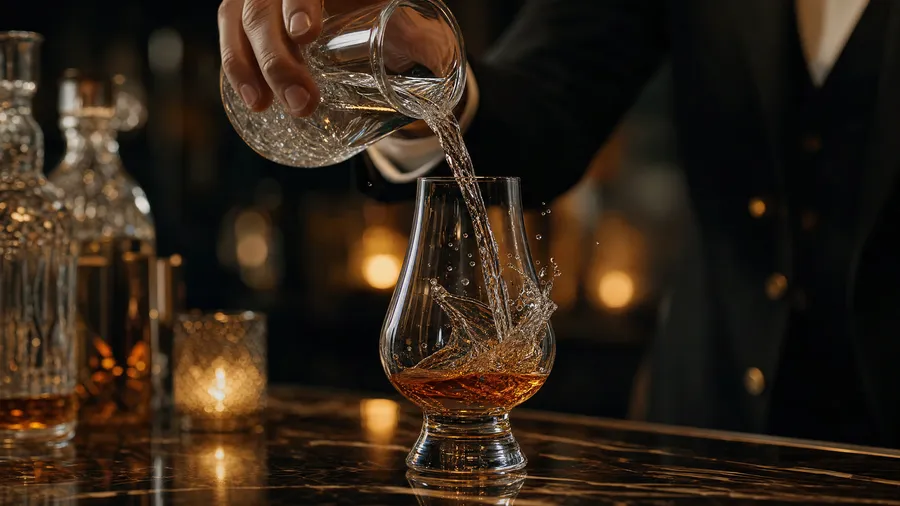
When a master distiller hands you a glass of their finest expression and says “add a drop of water,” they are not being casual. They know something that most drinkers don’t: the right amount of the right water changes what the whisky is.
The guaiacol theory
In 2017, researchers at Linnaeus University in Sweden published a study in Scientific Reports that gave the whisky world its most compelling scientific justification for adding water to Scotch. The key compound: guaiacol.
Guaiacol is a phenolic compound responsible for much of the smoky, peaty character in Scotch whisky. At cask strength (typically 60–65% ABV), guaiacol tends to bind with alcohol molecules deep in the liquid. It is present but suppressed — inaccessible to the sensory receptors in your mouth and nose.
Add water, and you lower the ethanol concentration. The alcohol-guaiacol bonds weaken. Guaiacol migrates toward the surface of the liquid. Your nose suddenly detects what was always there.
This is not unique to guaiacol. Most of the complex aroma compounds in whisky — the esters, the lactones, the aldehydes — have different solubility thresholds in water versus alcohol. Dilution selectively releases them.
Not all water is equal
This is where most of the whisky world stops asking questions. It shouldn’t.
If guaiacol migration is driven by lowering ethanol concentration, any water will technically do the job. But the experience of adding water to a fine whisky is not merely about unlocking aroma compounds. It is also about what the water itself contributes — or more precisely, what it does not contribute.
High-mineral water introduces competing flavours. Calcium interacts with tannins (from oak aging) and can increase perceived bitterness. Sodium at concentrations above about 30 mg/L adds a detectable metallic edge. Even magnesium, in sufficient quantities, adds astringency.
These mineral interactions do not dominate the whisky. But they subtly shift the flavour profile in ways that the distiller did not intend and the drinker may attribute to the whisky rather than the water.
Why a blending water is still, not sparkling
Sparkling water is tempting — the bubbles feel like they should help. They don’t. A blending water’s job is to lower the ethanol concentration so bound aromatics can escape, and still water does that cleanly. Carbonation adds two problems the dilution chemistry does not need.
First, CO₂ dissolved in water forms carbonic acid, which drops the pH and shifts how the spirit’s aroma compounds volatilise in the glass. Second, the bubbles push volatile aromatics off the surface too fast — the loudest top notes flash off and the mid-palate and finish complexity disappears before you can sense it. The result is a nose that is more dramatic and less complete.
This is also why distilleries proof their whisky down with still, demineralised water and never with anything carbonated: at the reduction stage the goal is to change the strength and as little else as possible. A blending water made for the glass follows the same logic. It is still by design.
What this means for Plezure
Plezure is built on this science. It is a still water. The TDS below 50 mg/L eliminates mineral interference, and the neutral pH means the water contributes nothing of its own — it simply lowers the strength and lets the spirit open.
In blind tasting panels conducted during development, trained tasters consistently reported that whisky diluted with Plezure had cleaner, more persistent aromatics than the same whisky diluted with standard still mineral water at the same ratio. The difference was not in the whisky. It was in the companion.
That is what we built Plezure to do.
Blenders International · Water Science series